Showing posts with label ovulation induction. Show all posts

Monday, September 16, 2013

Follicles Too Big In Clomid Ovulation Induction Cycle

Hello,
I am writing from San Diego, CA.  I was on 100mg Clomid on Cycle Day 3-7, then 2mg estradiol on cd 8-12. I went in for an ultrasound to check follicles on cycle day 13.  My RE said that this was most likely a lost cycle because I had 2 dominant follicles at 26 and 31 mm.  He gave me an HCG trigger because he did not want the follicles to get bigger and become cysts.  My uterine lining was 14 mm, and my RE was happy with that.  My husband and I had intercourse the day of the trigger and the day after, then skipped a day and had intercourse one more time.  


Were the follicles too big?  Do we have any chance of conceiving this cycle?  I have also been feeling cramps since yesterday at 7 days after the trigger.  Is this normal?  

Thanks for your input. L. from San Diego

Answer:
Hello L. from the U.S. (San Diego),

I don't have the ability to foresee the future, and certainly exceptions can occur, however, the follicle sizes were too big.  Usually once the follicle is greater than 24 mms, the egg within is overmature and therefore no longer viable.  Ovulation may occur but that is the main problem.  Also, it is highly likely that these follicles will turn cystic (persist) and have to be suppressed with birth control pills. You need to make sure a baseline ultrasound is done to evaluate for this at the start of your next cycle.

So, statistically and physiologically speaking, this cycle is probably a bust.  Unfortunately, your doctor missed the appropriate point by not doing the ultrasound early enough.  Next cycle he should begin looking at cycle day #9 or 10, which is what I do.  If I'm too early that's okay because nothing is lost and gives me a better idea of follicular development.  If you're too late, as in your cycle, then then cycle is lost; a big price to pay.

Good Luck,

Dr. Edward J. Ramirez, M.D., FACOG
Executive Medical Director
The Fertility and Gynecology Center
Monterey Bay IVF Program
www.montereybayivf.com

Monterey, California, U.S.A.

Thursday, November 3, 2011

Wondering About Follicle Size And Ovidrel Shot


Question:

Hi, I am on Gonal-f and my US (ultra-sound) yesterday showed I had 2 follicles measuring at 17mm and 14mm, my doctor told me to take one more shot of 75ui Gonal-f last night and to trigger with ovidrel tonight.

Do you think my eggs will be mature enough to ovulate???
Thanks! N. from the U.S.

Answer:

Hello N. from the U.S.,

If the follicles grow normally, they should increase by 2 mms each day. That means that they will be 19 and 16 mms the next day. I NEVER trigger without knowing the follicle size for sure. That is sloppy care. In addition, I would want you to be able to ovulate both follicles so I would probably wait one extra day and use the gonal-f another day. That way the follicle sizes should be 21 and 18 mms, so that both would be ovulatory size. Since follicles don't always follow the expected growth rate, I feel you have to look each day to know for sure.

In terms of your question, if the follicles grow to 19 mms and 16 mms the next day, then the 19 mm follicle definitely should ovulate and the 16 mm follicle may or may not.

Good Luck,

Dr. Edward J. Ramirez, M.D., FACOG
Executive Medical Director
The Fertility and Gynecology Center
Monterey Bay IVF Program
www.montereybayivf.com
Monterey, California, U.S.A.

Monday, September 26, 2011

Ovulation Induction With Follistim Keeps Failing & Estradiol Remains Low

Question:

We are currently TTC our 2nd baby. My daughter who is 2 was conceived on our second cycle of follistim75iu. We are currently on our 4th cycle of Follistim 75iu. Each cycle I'm told my estradiol is low and they end up increasing my dose of Follistim to 150 iu and even by the time I trigger it's still on the low side.

I understand that ideally estradiol should be 200-250per mature follicle. But this cycle it is 110 with follicle sizes of a 14 and a11. So at this point of my cycle what should it be since they are not mature follicles? Also last cycle they had me do hcg booster shots after ovulation because I had a low estradiol (it was 80) 7 days after ovulation the cycle prior. The boosters helped increase my estradiol to 354. My concern is do the boosters really help achieve pregnancy or are they just masking a bigger problem?? Thanks in advance, S. from Pennsylvania, U.S.A.

Answer:

Hello S. from the U.S. (Pennsylvania),

There is no fixed protocol when using gonadotropins such as Follistim. Basically, these medications are the hormone FSH which is the hormone that your brain produces to stimulate the ovary to produce a mature follicle for ovulation. If the amount of hormone is insufficient to do this, then it has to be increased and this is usually done on an incremental basis. Please see how I do ovulation inductions here: "Ovulation Induction".

For example, it may be started at 75IU but every three to four days, and estradiol level can be drawn and checked to see if it is increasing. If it is increasing then starting on cycle day #9, an ultrasound is done to evaluate the ovaries and see how many follicles are present, what their sizes are and when to trigger. In your case it sounds like that is not being done. For some reason, your doctor is fixated on keeping the same dosage. I'm not sure I understand why.

You are correct about the estradiol level of a mature follicle. If your follicle does not reach the mature size18-20 mms, then the estradiol level will not reach the appropriate size either. Basically the follicle increases in size by increasing the number of cells. Think of it as a chain of cells in a circle. These cells to increase in size, rather, more cells are added to the chain and each cell produces some estradiol. That is why as the follicle increases, more estradiol is emitted. In order for the follicles to grow more cells, increasing amounts of FSH is required. So, if your doctor stops the dosage at 150IU and it is not enough FSH to stimulate follicular growth, then nothing will happen. He needs to keep increasing the dosage until the follicle grows appropriately. Once the follicle reaches the ovulatory size of 18-24 mms, then ovulation can be triggered with HCG (a substitute for the LH surge you would produce in a natural cycle).

The "HCG booster shots" do nothing to help the estradiol rise. Rather, this was merely a coincidence. The growing follicle causes the increased estradiol. The HCG can be used after ovulation to help prime the enodmetrial lining for ovulation. Some clinics use this instead of progesterone. It is also used to trigger ovulation, as I've mentioned previously.

Based on the information you have given me, I'm wondering if you are seeing the right doctor. Your doctor may be comfortable with using Follistim, but is he really an infertility specialist i.e. have a thorough knowledge of the gonadotropins to use them for IVF (in vitro fertilization) if he has to? There are many Ob/Gyn docs that feel comfortable with ovulation induction and use gonadotropins like Follistim on a protocol basis, but in reality, don't know what they are doing. Could you be in that type of situation? Maybe it is time for a second opinion. The best way to find an infertility specialist is to simply ask the clinic or doctor, "Do you do IVF?".

Good Luck,
Dr. Edward J. Ramirez, M.D., FACOG
Executive Medical Director
The Fertility and Gynecology Center
Monterey Bay IVF Program
http://www.montereybayivf.com/
Monterey, California, U.S.A.

Friday, May 20, 2011

Canadian Needs To Know: Frequent Blood Draws Are NOT Necessary For Clomid Induction Cycle


Hello Dr. Ramirez,

I'm currently undergoing cycle monitoring and my RE has not yet been able to pinpoint a reason for our 18 months of infertility (hubby checked out okay and my initial tests - ultrasounds, blood work, saline hysterosonogram - show no problems other than possibly my age being a factor - 35).

I am on my second month now of ovulation induction cycle monitoring. At the clinic I go to (and it appears any of the ones that I have looked into here), they want to do cycle monitoring every single month regardless of whether it is a medicated or natural cycle. He said after this month, we will likely try something like Clomid to produce more eggs and continue with the cycle monitoring.

I could handle the ultrasounds, but the blood work has become such an issue for me I may not be able to continue with treatment. I have to go on CD3 and then daily starting again on CD10 until I ovulate which usually isn't until CD17-19 and then for a progesterone test 7 days post ovulation.

The problem is I have always had small veins that are difficult to get blood from. I've had several of the technicians try and they often try for more than 10 minutes with multiple pokes. I develop massive bruises so the subsequent tests are even worse. They told me I have almost no surface veins and even when they hit one, sometimes no blood comes out of it. They've tried my hand too which is very painful and the last time I was there, they talked to my RE and then they used my foot which also hurt a lot. One of the technicians today said they may have to move onto my groin or neck (but she laughed so I hope she was joking)! I've tried drinking lots of water as well as soaking my hands and arms in hot water without any success.

I talked to my RE and asked if the daily blood work is absolutely necessary each and every cycle and every visit and he said it is required because they need to closely monitor levels. I asked if I could go for the ultrasounds and monitor my LH surge using urine OPK tests and he said they require the blood work because they need to monitor things other than just LH and blood work is a requirement each day an ultrasound is done.

In your opinion is there any other option than all this blood work? I'm almost having panic attacks each day on the way to the clinic (and I've never had panic attacks before) because it gets worse everyday and I don't know how many more months I can deal with this. I'm concerned about future routine blood work as these daily tests are no doubt making my veins worse. At this point I don't want to tell many people about our fertility issues, but my arms make me look like a drug addict as they are covered in bruises.

I'm D. from Ontario, Canada.Thank you for your input.

Answer:

Hello D. from Canada,

I have never heard of such a ridiculous thing! Blood work is not required for simple ovulation induction whether by natural ovulation, Clomid ovulation or even low dose Follistim ovulation. The blood work that is done with IVF is done because the ovaries are being stimulated so strong that we need to make sure that overstimulation or hyperstimulation does not occur. It is NOT required for monitoring. The key to ovulation induction is NOT the blood test results but the number and size of the follicles as seen by ultrasound. Ovulation is timed by the size of the follicle NOT the blood test, and a midluteal progesterone is NOT needed if progeterone supplementation is given and/or ovulation is determined by ultrasound (which is a better method than the progesterone anyways).

I think your doctor, and this clinic, is treating you inappropriately and in essence, torturing you. I would strongly recommend that you change clinics immediately. I find this clinic abhorrent! If you review my blog where I discuss how I do ovulation induction, you will see that there is no mention of any blood tests except for a pregnancy test at the end of the cycle!

In terms of why you are not getting pregnant, if you have not had a laparoscopy then I would recommend that you have one. I often find that in patients that don't seem to have an obvious reason for infertility, that is, the basic workup has been normal, that they often have endometriosis in the pelvis. Endometriosis does not have to be symptomatic to cause infertility.

If you can't find a fertility clinic in Canada that will do the ovulation induction without blood tests, then you should come to my clinic in California. At least I can save you from being tortured. Please seek out the appropriate level and standard of care!

Good Luck,

Dr. Edward J. Ramirez, M.D., FACOG
Executive Medical Director
The Fertility and Gynecology Center
Monterey Bay IVF Program
http://www.montereybayivf.com/
Monterey, California, U.S.A.

Sunday, June 6, 2010

The Ten Natural Steps To Pregnancy: Where Do Ovulation Induction And IUI Matter Most?


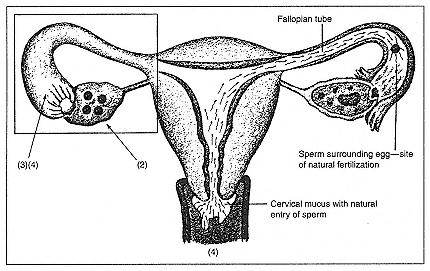
Today's blog post is an attempt to clearly state the Ten Natural Steps that a woman's body needs to accomplish in order to achieve pregnancy. Ovulation Induction and Intra-Uterine Insemination are treatments that give an additional "boost" to a natural pregnancy path.

Step 1: The Hypothalamus/Pituitary complex secretes FSH and LH into the blood stream to stimulate the ovary and start the process toward ovulation.

Step 2: The ovary activates several follicles to start growing but only one becomes the dominant ovulatory follicle.

Step 3: Once the follicle reaches the appropriate size (24 mms), the hormone LH surges, the follicle ruptures and the egg is released into the culdesac, where the fimbria of the tubes are laying.

Step 4: The egg has to find and enter one of the fimbria to get into the tube.

Step 5: The sperm have to be waiting in the tube and when the egg enters, the sperm collect on the egg.

Step 6: Fertilization has to occur by one sperm entering the egg. The egg and sperm's genetic material unite.

Step 7: The fertilized egg divides and grows into an embryo (as it courses down through the Fallopian Tube over the next seven days).

Step 8: The embryo enters the endometrial cavity.

Step 9: The embryo has to hatch and the inner cell mass exits the shell and attaches to the endometrial lining.

Step 10: The endometrial lining has to grow around and accept the embryo (implantation). Pregnancy test will now turn positive and the embryo slowly develops into a fetus.

OVULATION INDUCTION assists in steps 1, 2 & 3.

INTRA UTERINE INSEMINATION assists in steps 1, 2, 3, & 5.


Sunday, April 25, 2010

Kuwaiti Woman Asks: How To Thicken My Endometrium Lining?


Question:

Hi Dr. Ramirez,

I feel am really blessed to find someone very expert and caring like you :)

This is N. from Kuwait, I am very concerned about my endo thickness (was between 6.5 to 7.9 on CD14). On the other hand, I don’t want to take medicine that may harm me. The dr. is giving me Duphaston and Progyluton. The Norgestrel is combined with Estradiol valerate in one pill that comes in medicine call Progyluton (I don’t know if you know it). 11 white tablets each containing Estradiol valerate and 10 light brown tablets to be taken from CD16, each containing Estradiol valerate and Norgestrel). You have said previously that the Norgestrel is not used in the USA to treat endos.

What about the Duphaston which is Dydrogesterone 10 mg- Orally – 2 times a day from CD14? Should I take it Vaginally? Does it hurt? What do you suggest? Should I take natural Progesterone instead of the Duphaston? If yes, would you please give me name of the medicine?

Unfortunately it seems there are not that good doctors over here, they are RE and Gyno. This is the 3rd doc. The 2nd doc believes that clomid will increase the endo because it produces eggs; and she sees endo thickness 7 or 8 mm is not bad!!! Dr. Ramirez, If you don’t mind to give me Online Consultancy and I will PAY for it (I can call). Write me a prescription with what should I take and when and how? For example estrace from CDx to CDx, and then XXX medicine from CDxx. (I can order them online)

I know that it sounds weird, but with the globalization and the existence of internet the behaviors and habits are changing. I will go to the doctor on CD14 (or whenever you think is the best) to do the ultrasound and then will let you know about the size of eggs, endo and so on :)

Thank you!

Answer:

Hello N. from Kuwait,

The Duphaston can be used vaginally. Progesterone is important to help with implantation. I would NOT recommend the Progyluton. It is used from hormone replacement therapy and cycle control. It is not used in infertility because of the Norgestrel. Although the Estradiol component is okay, and necessary to increase the uterine lining, the Norgestrel (progesterone) will compete with the estrogen and keep the lining thin. With this combination women don't usually have periods, which is the reason why it is used for menopausal hormone replacement therapy. In fertility cycles, the first half of the cycle needs to have unopposed estrogen stimulation so that the lining will grow. Then once ovulation occurs, the progesterone is introduced to help the lining convert to a luteal phase lining so that implantation can occur.

Your proposal for an internet consultancy is interesting, I will send you an email. I'll have to think about that one. In terms of your supplementation, I use the following protocol:

1. I use the estrogen patch for estrogen supplementation such as the Climara patch. I use two 0.1 mg Climara patches beginning at the start of the cycle and continuing until the pregnancy test. If it is positive, then I continue it until you are 10 weeks pregnant.

2. For progesterone, I use a product called Endometrin 100 mg vaginal tablets. You place 1 vaginally twice per day beginning on cycle day # 16, or beginning with the HCG injection if you use an HCG trigger for ovulation. You would then continue this until the pregnancy test or 10 weeks gestational age if you get pregnant. Other forms of progesterone that you can use in the same way are Prometrium 100 mg or Crinone/Procheive 8% cream.

If you look up my blog regarding how I do Clomid ovulation inductions, it will give you directions on how I recommend doing Clomid cycles. Normally, as the follicles are stimulated and grow, they produce increasing amounts of estrogen. This then goes to the uterine lining and increases it. The problem with Clomid, however, is the way it works. It blocks estrogen receptors in the reproductive system and tricks the brain into thinking that it is not producing enough estrogen. So the brain responds by increasing the amount of stimulation of the ovary, hence ovulation is stimulated or multiple eggs are stimulated. By blocking the receptors, however, it can cause the uterine lining (endometrium) to no grow sufficiently.

Don't stress too much over all this, please take your time and copy these instructions. Take the time to discuss this thoroughly with your physician and good luck!

Sincerely,

Edward J. Ramirez, M.D., FACOG
Executive Medical Director
The Fertility and Gynecology Center
Monterey Bay IVF Program
Monterey, California, U.S.A.

Thursday, April 15, 2010

How I Do Clomid Induction Cycles...A Controlled Cycle Approach


Dear Readers,

Recently, I received a private question regarding the use of Clomid in a natural ovulation cycle. This 31 year old patient has been seeing an OB/Gyn for her infertility evaluation and treatment. She has gone through eight failed natural cycles, "diligently" using ovulation charts and opk's. After seeing her doctor, she was put on Clomid. "My first appointment, she never asked me what specific day I was ovulating, just ordered the blood work. Thus, I scheduled the second appointment to assert my concern. She proceeded to prescribe me 50mg of Clomid on days 5-9." Unfortunately, this patient failed with her first cycle using Clomid and is unsure how to proceed.

I know that there are many of you out there with similar concerns, so I have decided to publish my response to her question by outlining my Clomid timed ovulation protocol. As an infertility specialist and an Ob/Gyn, this is the approach that has yielded success for me with patients like the one above.

Her closing concerns mirror many others I have received in the past: "What would be your advice for me at this point in the process? Should I be patient and continue with Clomid and not be concerned with late ovulation? Should I go to a different ob-gyn or assert myself more with my current Dr? Or, should I go to a fertility specialist?".

Answer:

Hello J. from the U.S.,

First, let me explain how I do Clomid ovulation induction cycles, which is the way that I recommend. I DO NOT recommend just taking clomid and trying to time intercourse on your own (noninterventional method), which is what a lot of OB/GYN's like to do.

1. Patient calls with onset of period or within the first five days of onset. She is scheduled to be seen within the first five days of the cycle.

2. Patient comes in for a baseline ultrasound to evaluate for the presence of an ovarian cyst. Ovarian cysts are a contraindication to using fertility medications and will interfere with the cycle. The cyst may just get bigger and ovulation will not be accomplished.

3. Treatment calendar is made up showing when everything is going to happen, approximately.

4. Patient stops having intercourse on cycle day #10.

5. Patient returns on cycle day #10, 11 or 12 for vaginal ultrasound to check for: whether she is responding to that dose of Clomid as manifest by multiple growing follicles, how many follicles are growing and if the follicular size is appropriate for ovulation. Serial daily or every other day ultrasounds are done until the ovulatory follicle(s) reach the appropriate size of 18-24 mms.

6. Once the follicles reach the appropriate size, HCG is given to trigger ovulation.

7. If a timed intercourse cycle, the patient begins intercourse the next day for four consecutive days, only one ejaculation per day. If an IUI cycle, the patient has an IUI the next day and following day.

8. Vaginal progesterone is then started either on the 5th day after trigger if a timed intercourse cycle, or the day after the second IUI, and continued until the pregnancy test.

9. Blood pregnancy test is done two weeks after the trigger and the progesterone is NOT stopped until this result is negative. If positive, it is continued until 10 weeks gestational age. We DO NOT wait for onset of menses, because often it will not come if progesterone is taken.

If this is not the way that your doctor is using Clomid, then he/she is not treating you appropriately in my opinion, and you should find someone who will. Usually a fertility specialist is the appropriate choice, but there are many general Ob/Gyn's who do fertility well. The purpose of Clomid in your case, is to get your ovaries to function normally. Usually that will regulate your ovulatory cycles and you will ovulate by cycle day # 14. Clomid often shortens the follicular phase (first two weeks), if an appropriate dose is used. Clomid can be given in doses from 50 mg to 250 mg. The doctor has to find what the lowest appropriate dose is and that is done by trial and error. Without checking with the ultrasound, he/she can't know how you are responding. In clomid cycles you don't want more than 5 ovulatory sized follicles. Also, you don't want to do consecutive months with Clomid because it blocks estrogen receptors and can lead to poor endometrial lining and poor cervical mucous. Clomid is one of the most misused drugs in the U.S.

Sorry for the mass of information, but I hope this will give you what you need to know to make an appropriate informed decision.

Good Luck,

Edward J. Ramirez, M.D., FACOG
Executive Medical Director
The Fertility and Gynecology Center
Monterey Bay IVF Program
Monterey, California, U.S.A.

Friday, April 2, 2010

U.K. Infertility Patient Had Four Fibroids Removed, Now Has Pain Upon Ovulation - Ovarian Adhesions?


Question:


Hi Dr. Ramirez,

I am a 28 year old lady who has been trying to conceive for 18 months. I had an ectopic pregnancy last June, but thank God both tubes are still intact as I was diagnosed early.

I decided to have a laparoscopy in February 2010 to find out what is wrong and my doc took out 4 fibroids and I also had mild adhesions to the right ovary but apart from that the tubes and the uterus looked healthy. But since the laparoscopy, I have been having this unbearable ovulation pain on the right side which I never experienced before. It lasts for 3-4 days. The pain is very uncomfortable and right hand side of the abdomen is very sore and tender. It feels exactly like the pain I had when I had the ectopic.

My question is could the adhesions be back on the right ovary already? If so, if they were mild before the lap, is it possible they got worse after the lap? Also, would the laparoscopy affect the functioning of the ovary as I have been having abnormal basal body temperature since the lap.Lastly, is it possible to ovulate from the same ovary every month, as I don't think I am ovulating from the left ovary at all?

Is my only chance of conceiving IVF?

Many thanks in advance for your suggestions. Regards, B. from the U.K.

Answer:

Hello B. from the U.K.,

Yes, adhesions can return and usually return within 24 hours. Also, any surgery, including laparoscopy, can result in adhesion formation. Normally, when you ovulate, your ovaries swell thereby "moving". Unfortunately, the adhesions may be fixing the ovary in place causing you to have uncomfortable pain. I would not expect the laparoscopy to affect your ovarian function if the ovary was not damaged in any way or its blood flow affected.

Yes, it is possible to ovulate from the same ovary every month.

My opinion is that you have tubal disease that was probably caused by some type of event, like an infection in the past. That usually leads to internal tubal damage and scar tissue formation. If significant enough, you can also get scar tissue within the pelvis and around the ovary and tubes. The main problem is that if there is damage within the tube, it cannot be fixed. These internal adhesions are probably what caused the embryo to get stuck in the tube, leading to the ectopic. Certainly patients that have had ectopics before do subsequently have normal pregnancies, but there is no way to know which category you will fall into. With the combination of problems, ectopic and peri-tubal adhesions, I would expect that your natural chances of pregnancy are low, in which case, IVF would be the treatment of choice. That is how I would advise you in my clinic. You could certainly continue trying with a more natural method such as ovulation induction with timed intercourse or ovulation induction with IUI. You need to be seen right away if you get pregnant because of your increased risk of recurrent ectopic.

If you don't get pregnant after a period of time, I would set it at 6 months or no more than 4 IUI attempts, then I would proceed directly to IVF.

Good Luck,

Edward J. Ramirez, M.D., FACOG
Executive Medical Director
The Fertility and Gynecology Center
Monterey Bay IVF Program
Monterey, California, U.S.A.

Wednesday, February 10, 2010

U.K. Patient with Inactive Pituitary and History of Bulimia Trying To Conceive


Question:

Dear Dr Ramirez,first of all I would like to thank you for taking the time to read my question. I'll give you a brief history of my problem. I have a history of anorexia/bulimia which became very serious when I was 18, I lost around 20 kilos of weight in under two months when I was 19 and since then have not had my periods. I am now 27 (will be turning 28 in three months). I also developed bilateral, simple, unilocular ovarian cysts that were removed through laporoscopy when I was 23.

I am 99.99% cured of my eating disorder now, my weight and BMI is normal, but my estradiol levels are extremely low (around 40 whereas they should be around 400 (?) at my age?). All other causes of secondary amenorrhea have been ruled out, I have been thoroughly checked and there is no problem with my ovaries, fallopian tubes or uterus, and the hormonal levels show an inactive/hypoactive pituitary.

It might help to add here, when I was about 24, I had an attack of ventricular fibrillation due to low potassium levels because of all the purgeing. The blood supply to my brain was compromised for about 5 - 10 minutes (if not more). I was wondering if that might have affected my pituitary in some way. I recently got a bone density scan done and I have developed osteopenia, because of the low estrogen levels for so long.

From age 19/20 to 25/26 I have been on and off of contraceptive pills, which were being prescribed to me first to deal with the ovarian cysts, and after the removal of the cysts, as HRT, but at that time my weight and BMI were below normal.I have recently brought my weight to normal (my BMI had been around 18 since last year, and I have brought it to 20 - 21 just recently after being told by my doctor to do so)and I have been put on Prempak C as HRT (one month ago) after being off of any contraceptive pills or anything for more than a year.

My questions are:

1) Will this HRT with Prempak C help awaken my pituitary? so that my periods might become regular on their own? Or will I be on HRT for life?

2) Will I regain my bone density with the help of this treatment?

3) I am married now and we are trying to conceive, could you please tell me what the risks involved would be? I mean will my low bone density be a problem? Will I be able to sustain the pregnancy with my inactive pituitary? Will my condition affect the health of my child?

Thank you so much for your time and consideration. Kindest Regards.

Answer:

I am glad to hear that you are almost cured of your eating disorder. As you know, the worst outcome is death from such a disorder.

The decreased oxygen insult could certainly have affected your pituitary, causing it to become inactive. We have seen similar cases after hemorrhage from childbirth. If that is the case, your FSH and LH levels will be almost 0. You would have what is called hypogonadotropic hypogonadism i.e. the ovarian function would be low because of low pituitary stimulation. In that case, you will need to receive pituitary hormones for the ovary, thyroid and adrenal in order to have a normal body function. If you have normal thyroid and adrenal function now, then you do not have this disorder, only an ovarian dysfunction. Female hormone levels must be checked on the 2nd or 3rd day of the menstrual cycle in order to find the baseline because the levels vary during the cycle. The estrogen level that you report is within the normal limits. 400 is not a normal findings unless you are undergoing fertility treatments. The peak estradiol level in the mid-cycle is around 200-250. If the anorexia was the cause of your lack of ovarian function, then with return of your body to normal, that should return your ovarian function. If it does not, then there could be an inherent ovarian dysfunction as well.

I do not believe in bone density tests. I have NEVER seen a woman have a normal test. Everyone, has osteopenia based on these tests, so I can't give a lot of credibility to the results. That being said, however (my bias#, if you have a lack of estrogen production, you can certainly develop osteoporosis, as well as other problems. For that reason, it is important to have estrogen replacement therapy if you are not producing it on your own. The easiest and best method for a young woman under 45 yo is to use the birth control pill. Menopausal hormone replacement therapy, like what you are taking, is NOT made for young woman and does not give sufficient estrogen for your increased metabolic requirements. The birth control pill is better because it has an increased amount of estrogen.

If you are trying for pregnancy, that is another issue and should take precedent. Of course, you cannot be on the birth control pill if you are trying for pregnancy. Getting your weight up to normal is a good start. If ovarian function does not return on its own, then you will need medication to induce ovulation. Without ovulation, you cannot get pregnant using your own eggs. In that case, you need to see a reproductive endocrinologist to diagnose what needs to be treated (pituitary or ovary) and place you on the correct regimen and hormonal supplementation. Once your pregnancy gets past 8 weeks gestational age, the placenta will produce the hormones that it needs, so you will no longer require the supplements. Your child's health and well being will be independent of this treatment.

I'm sorry for the long reply, and the short reply. I cannot cover all the topic in detail because it would take too much space. What you have is a complex issue, but easy to treat if you are in the right hands. Don't worry.

Follow-up Question:

Dear Dr Ramirez,

I'm extremely thankful for your detailed response, I feel very comforted as well that you understand my situation and also that I understand it better now myself too!
I just wanted to tell you that my FSH and LH is within normal range, so I'm glad it's not hypogonadotropic hypogonadism, which I guess is good news.

Secondly, I'm very happy that it's no big deal that my come density scan showed osteopenia as you say bone density scans are not accurate, but my aunt also got hers done, she's a young 53 yo and her scan showed normal come density. But I feel fine really, no bone pains or anything.

Could you please tell me further that with normal weight and normal eating habits, how long it might take for my normal cycles to start on their own? And if there is anything further that I can do or discuss with doctors here to help me get better?

Thank you very much again.

Follow-up Answer:

Hello Again,

Good to hear that your FSH and LH are normal. Then, we can assume it's an ovarian dysfunction. Normally, I would expect your periods to resume within 4-6 months of achieving a normal weight, but to speed things up, you could go directly to ovulation induction (if you're trying for pregnancy or the birth control pill for three months to kick start your ovary).

Sincerely,
Edward J. Ramirez, M.D., FACOG
Executive Medical Director
The Fertility and Gynecology Center
Monterey Bay IVF Program
Monterey, California, U.S.A.

LinkWithin

Related Posts with Thumbnails