Showing posts with label ovulation. Show all posts

Saturday, July 23, 2011

Calendar Method Vs. OPK? It's All In The Timing...


Question:

So my husband and I are trying for our first child. We've trying for about 3 months with no luck yet. i was thinking of trying the ovulation test but i'm not sure if its worth it. I've read online that they can help but i figure it would never hurt to ask. Do you know much about them and if there worth the money or should i just track my temp every morning.Thanks for the help! S. from Canada

Answer:

Hello S. from Canada,

An ovulation predictor kit (OPK) does not help any more than timing it well. I don't recommend it to my patients. Instead, I recommend the calendar timing method. It goes like this:

CD#1 The day your period starts. Mark you calendar then count each day. For instance the next day is cycle day #2, then cycle day #3 etc.

CD#10 Stop having intercourse. You can have regular intercourse until that day but you have to stop on that day.

CD#13-17 Assuming you have normal regular cycles, this is your fertile period. You should have intercourse each day, only once per day and only one ejaculation per episode. After cycle day #17 you can resume your normal frequency.

Keep in mind that 85% of women under the age of 30 take 8-12 months to achieve pregnancy so you have not yet been trying long enough. Hopefully this method will help.

Good Luck,
Dr. Edward J. Ramirez, M.D., FACOG
Executive Medical Director
The Fertility and Gynecology Center
Monterey Bay IVF Program
http://www.montereybayivf.com/
Monterey, California, U.S.A.

Comment: Ok thank you so much for the advice! I'm going to try the calendar method.

Saturday, February 19, 2011

HCG Trigger Shot Must Be Timed With Ultrasound Surveillance NOT With Calendar Dating When Doing IUI


Question:

I am writing from Hawaii with several questions. We will be undergoing our first IUI soon. The background is the following: I am 36 years old with no fertility factors. We decided to seek out fertility help because my husband, also 36, has an ejaculatory issue. I have been using Follistim AQ for the past 10 days and have two more days to go. My doctor instructed me to use my hCg shot at 11pm the night before my IUI. My first question is this, with only a 13 hour window between my hCg shot and IUI is this optimal? I have read that 36 hours is best.

Also, my normal cycle length is 26-27 days, I will be inseminated on day 16, will I still follow my normal cycle and expect to see my period on day 26? Should I ask my specialist for Progesterone supplements? I had 5 decent sized follicles 5 days ago, all between 10 and 12mm. Today during my ultrasound only 2 follicles were visible, one at 14mm and one at 15mm. I have been using a ClearBlue Easy fertility monitor, which said 3 days ago I was reaching peak fertility. Is it possible I already ovulated one or more egg? Thank you so much for your time. My doctor is a good doctor, but very busy and I often don't formulate my questions until after I have left the office. Mahalo! H. from Hawaii

Answer:

Hello H. from Hawaii,

First, let me say that I am a little skeptical of your doctor, based on your questions.

The optimal size for a follicle at ovulation is 18-20 mms. Using Follistim, your cycle should not be timed based on a calendar, but on the growth and size of your folllicles. In addition, at your age, the maximum number of ovulatory follicles should be no more than 3 because of the significant increased risk of a super-multiple if there is more than 3. So, the proper way to do this is daily ultrasound, if necessary, as your follicles reach closer to the 18 mm point. Once the follicle is 18 mm (my personal preference is 20mms), then the HCG shot is given and the IUI is done at 36 hours if only one IUI is done or at 24 and 48 hrs if two are done (My preference is the two IUI protocol).

The times don't have to be exact. The sperm just needs to be there reasonably close to ovulation and precede ovulation. Since it cannot be known exactly when ovulation occurs and it is know that it can take up to 12 hours for the egg to find and enter the tube, exact timing cannot be done. In general, follicles grow at 2mms per day but this can vary as well. That is why close ultrasound surveillance needs to be done as you get closer. If your doctor solely uses a calendar date, such as cycle day #16, there is a possibility of missing ovulation, which essentially dooms this cycle. In any case, based on a 27 day cycle (and counting backwards), you would ovulate at around cycle day #13 not #16.

I ALWAYS supplement with progesterone. It is an easy thing to do and there is no downside risks. If you have inadequate stimulation of progesterone in the luteal phase, you risk non-implantation and/or early miscarriage. I hate to take that chance when I can cover the risk by adding a little progesterone. I have written extensively regarding timing and doing IUI's in my blog. I would recommend you review that material and discuss your concerns with your physician.

Good Luck,

Edward J. Ramirez, M.D., FACOG
Executive Medical Director
The Fertility and Gynecology Center
Monterey Bay IVF Program
Monterey, California, U.S.A.

Sunday, June 6, 2010

The Ten Natural Steps To Pregnancy: Where Do Ovulation Induction And IUI Matter Most?


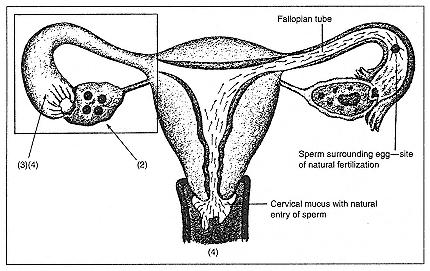
Today's blog post is an attempt to clearly state the Ten Natural Steps that a woman's body needs to accomplish in order to achieve pregnancy. Ovulation Induction and Intra-Uterine Insemination are treatments that give an additional "boost" to a natural pregnancy path.

Step 1: The Hypothalamus/Pituitary complex secretes FSH and LH into the blood stream to stimulate the ovary and start the process toward ovulation.

Step 2: The ovary activates several follicles to start growing but only one becomes the dominant ovulatory follicle.

Step 3: Once the follicle reaches the appropriate size (24 mms), the hormone LH surges, the follicle ruptures and the egg is released into the culdesac, where the fimbria of the tubes are laying.

Step 4: The egg has to find and enter one of the fimbria to get into the tube.

Step 5: The sperm have to be waiting in the tube and when the egg enters, the sperm collect on the egg.

Step 6: Fertilization has to occur by one sperm entering the egg. The egg and sperm's genetic material unite.

Step 7: The fertilized egg divides and grows into an embryo (as it courses down through the Fallopian Tube over the next seven days).

Step 8: The embryo enters the endometrial cavity.

Step 9: The embryo has to hatch and the inner cell mass exits the shell and attaches to the endometrial lining.

Step 10: The endometrial lining has to grow around and accept the embryo (implantation). Pregnancy test will now turn positive and the embryo slowly develops into a fetus.

OVULATION INDUCTION assists in steps 1, 2 & 3.

INTRA UTERINE INSEMINATION assists in steps 1, 2, 3, & 5.


Friday, April 30, 2010

PCOS Patient Taking Natural Progesterone Cream For Cycles: NPC Does Not Help You To Ovulate, Only Regulates Cycle


Question:
Hi,

I have long cycles and was recently diagnosed with PCOS. Prior to my diagnosis I have tried everything under the sun to regulate them and help me to ovulate. Vitex, Evening Primrose Oil, Dr John Lee's Shutdown, (in which Natural Progesterone Cream is applied for CD's 5-26, then stopped) a couple unmedicated cycles, soy isoflavones, currently on 1000mg/day of Metformin and the ONLY cycles I had "normal" cycle length with ovulation, is when I took NPC (25mg/BID) from CD's 5-26 (or til Aunt Flow) I know normally NPC should suppress ovulation, but instead for me it helps me ovulate. Why would that be? I cannot make sense of it at all, but am impressed that this is all it took.

I recently had an appointment with my dr, who actually told me that the NPC would do me no good in the beginning of my cycle and I should stop the NPC and start BCP's for a while to help get my cycles regulated again.

Thank you,

L. from Oregon

Answer:

Hello L. from Oregon,

Natural progesterone cream (NPC) will NOT get you to ovulate, but will help to keep you regular. In fact, you don't need to take it as many days as you are taking if all you want is to have a period on a regular basis. All you have to do is use it on CD#16-25 (10 days). When you withdraw the progesterone, you will have a period, because that is what happens in the luteal phase of the cycle. The progesterone is working directly on the endometrial lining and causing it to "luteinize" which is why withdrawal of the hormone causes it to breakdown and bleed. We use other forms of "natural" progesterone such as prometrium, Crinone, Procheive, Endometrin and Provera to accomplish the same task. But the progesterone does nothing to the ovary so ovulation does not occur. In large enough doses of progesterone, as that contained in birth control pills, it will cause a suppression of ovarian function.

The birth control pill is only a treatment to regulate your cycles. If a woman with PCOS is not intending to become pregnant, then the treatment of choice is to use the birth control pill. On the other hand, if your goal is to start ovulating, because you want to get pregnant, then as a woman with PCOS you need to use a medication that will induce the ovaries to ovulate such as Clomid, Femara or injectable medications.

I hope this helps to explain things,

Edward J. Ramirez, M.D., FACOG
Executive Medical Director
The Fertility and Gynecology Center
Monterey Bay IVF Program
Monterey, California, U.S.A.

Thursday, March 25, 2010

Is There A Link Between Late Ovulation And Miscarriage?


Question:

I recently read (in "Making Babies" by Dr. Sami David) that a follicular phase that lasts more than 20 days is a problem because it means the estrogen is building up too slowly which results in deterioration in egg quality and an increased risk of chromosomal abnormalities.

I recently experienced a missed miscarriage at 11 weeks. The cycle I conceived, my follicular phase was 30 days and I'm wondering if continued late ovulation could be increasing my risks of experiencing this again? Your thoughts?

J. from New York

Answer:

Hello J. from the U.S.,

I do not agree with Dr. David, and do not know where he would get that information. There is no relationship between follicular phase length and miscarriage. Most miscarriages occur because of some overt abnormality of the embryo or pregnancy, and usually are specific just to that particular pregnancy. Most patients with miscarriages will ultimately have a successful pregnancy.

Good Luck,

Edward J. Ramirez, M.D., FACOG
Executive Medical Director
The Fertility and Gynecology Center
Monterey Bay IVF Program
Monterey, California, U.S.A.
Twitter with me at @montereybayivf

Wednesday, February 10, 2010

U.K. Patient with Inactive Pituitary and History of Bulimia Trying To Conceive


Question:

Dear Dr Ramirez,first of all I would like to thank you for taking the time to read my question. I'll give you a brief history of my problem. I have a history of anorexia/bulimia which became very serious when I was 18, I lost around 20 kilos of weight in under two months when I was 19 and since then have not had my periods. I am now 27 (will be turning 28 in three months). I also developed bilateral, simple, unilocular ovarian cysts that were removed through laporoscopy when I was 23.

I am 99.99% cured of my eating disorder now, my weight and BMI is normal, but my estradiol levels are extremely low (around 40 whereas they should be around 400 (?) at my age?). All other causes of secondary amenorrhea have been ruled out, I have been thoroughly checked and there is no problem with my ovaries, fallopian tubes or uterus, and the hormonal levels show an inactive/hypoactive pituitary.

It might help to add here, when I was about 24, I had an attack of ventricular fibrillation due to low potassium levels because of all the purgeing. The blood supply to my brain was compromised for about 5 - 10 minutes (if not more). I was wondering if that might have affected my pituitary in some way. I recently got a bone density scan done and I have developed osteopenia, because of the low estrogen levels for so long.

From age 19/20 to 25/26 I have been on and off of contraceptive pills, which were being prescribed to me first to deal with the ovarian cysts, and after the removal of the cysts, as HRT, but at that time my weight and BMI were below normal.I have recently brought my weight to normal (my BMI had been around 18 since last year, and I have brought it to 20 - 21 just recently after being told by my doctor to do so)and I have been put on Prempak C as HRT (one month ago) after being off of any contraceptive pills or anything for more than a year.

My questions are:

1) Will this HRT with Prempak C help awaken my pituitary? so that my periods might become regular on their own? Or will I be on HRT for life?

2) Will I regain my bone density with the help of this treatment?

3) I am married now and we are trying to conceive, could you please tell me what the risks involved would be? I mean will my low bone density be a problem? Will I be able to sustain the pregnancy with my inactive pituitary? Will my condition affect the health of my child?

Thank you so much for your time and consideration. Kindest Regards.

Answer:

I am glad to hear that you are almost cured of your eating disorder. As you know, the worst outcome is death from such a disorder.

The decreased oxygen insult could certainly have affected your pituitary, causing it to become inactive. We have seen similar cases after hemorrhage from childbirth. If that is the case, your FSH and LH levels will be almost 0. You would have what is called hypogonadotropic hypogonadism i.e. the ovarian function would be low because of low pituitary stimulation. In that case, you will need to receive pituitary hormones for the ovary, thyroid and adrenal in order to have a normal body function. If you have normal thyroid and adrenal function now, then you do not have this disorder, only an ovarian dysfunction. Female hormone levels must be checked on the 2nd or 3rd day of the menstrual cycle in order to find the baseline because the levels vary during the cycle. The estrogen level that you report is within the normal limits. 400 is not a normal findings unless you are undergoing fertility treatments. The peak estradiol level in the mid-cycle is around 200-250. If the anorexia was the cause of your lack of ovarian function, then with return of your body to normal, that should return your ovarian function. If it does not, then there could be an inherent ovarian dysfunction as well.

I do not believe in bone density tests. I have NEVER seen a woman have a normal test. Everyone, has osteopenia based on these tests, so I can't give a lot of credibility to the results. That being said, however (my bias#, if you have a lack of estrogen production, you can certainly develop osteoporosis, as well as other problems. For that reason, it is important to have estrogen replacement therapy if you are not producing it on your own. The easiest and best method for a young woman under 45 yo is to use the birth control pill. Menopausal hormone replacement therapy, like what you are taking, is NOT made for young woman and does not give sufficient estrogen for your increased metabolic requirements. The birth control pill is better because it has an increased amount of estrogen.

If you are trying for pregnancy, that is another issue and should take precedent. Of course, you cannot be on the birth control pill if you are trying for pregnancy. Getting your weight up to normal is a good start. If ovarian function does not return on its own, then you will need medication to induce ovulation. Without ovulation, you cannot get pregnant using your own eggs. In that case, you need to see a reproductive endocrinologist to diagnose what needs to be treated (pituitary or ovary) and place you on the correct regimen and hormonal supplementation. Once your pregnancy gets past 8 weeks gestational age, the placenta will produce the hormones that it needs, so you will no longer require the supplements. Your child's health and well being will be independent of this treatment.

I'm sorry for the long reply, and the short reply. I cannot cover all the topic in detail because it would take too much space. What you have is a complex issue, but easy to treat if you are in the right hands. Don't worry.

Follow-up Question:

Dear Dr Ramirez,

I'm extremely thankful for your detailed response, I feel very comforted as well that you understand my situation and also that I understand it better now myself too!
I just wanted to tell you that my FSH and LH is within normal range, so I'm glad it's not hypogonadotropic hypogonadism, which I guess is good news.

Secondly, I'm very happy that it's no big deal that my come density scan showed osteopenia as you say bone density scans are not accurate, but my aunt also got hers done, she's a young 53 yo and her scan showed normal come density. But I feel fine really, no bone pains or anything.

Could you please tell me further that with normal weight and normal eating habits, how long it might take for my normal cycles to start on their own? And if there is anything further that I can do or discuss with doctors here to help me get better?

Thank you very much again.

Follow-up Answer:

Hello Again,

Good to hear that your FSH and LH are normal. Then, we can assume it's an ovarian dysfunction. Normally, I would expect your periods to resume within 4-6 months of achieving a normal weight, but to speed things up, you could go directly to ovulation induction (if you're trying for pregnancy or the birth control pill for three months to kick start your ovary).

Sincerely,
Edward J. Ramirez, M.D., FACOG
Executive Medical Director
The Fertility and Gynecology Center
Monterey Bay IVF Program
Monterey, California, U.S.A.

Thursday, November 19, 2009

Polycystic Ovarian Disease In Young Woman


I have had many, many questions regarding Polycystic Ovarian Syndrome or Polycystic Ovarian Disease. As an infertility specialist, I see women every week that suffer from either the syndrome or the disease. If not treated, it can lead to serious health problems such as diabetes and heart disease. It can also cause infertility. PCOS or PCOD is common and affects as many as 1 in 15 women. Often the symptoms will begin in a woman's teen years, like the following questioner from Texas.

Question:

Hi Dr. Ramirez,

I am a 19 year old black female in Texas looking for answers. I started having periods at 12, but I have never had a normal, monthly cycle. I generally skip 3-6 months, after which I have a period lasting anywhere from 2 weeks to 3 months. At first, because I am hirsute and I was overweight, it was thought that I had polycystic ovarian syndrome, but I have been tested numerous times for such and I don't have that. During my long periods it was thought that I had uterine fibroids, for which I was also tested negative more than once.

I've lost 35 lbs. but I still have the same issue. Now I have a "bloodless period", with a brownish or clear fluid. I have been to 4 different ob/gyn's, non with a conclusive answer. The reason I post this in the infertility section is because I don't believe I am fertile, but I want to know what is causing my infertility so maybe I can go and get help to resolve the issue.

Thank you so much!

Answer:

You have PCOD. The is NO specific test for this disorder. It is a clinical diagnosis, which means that it is based on the signs and symptoms. If you have hirsutism, increased weight and very irregular periods, that is enough to make the diagnosis. PCOD has a wide variety of presentations. Some will have an FSH/LH imbalance on blood testing, but not all. Some will have irregular periods, but not all. Some will have increased hair growth, but not all. Some will have elevated insulin levels, but not all. The point is, your doctors are wrong. You have PCOD.

Therefore, you should be on the birth control pill to control your cycles. The problem with PCOD is that the ovary is dysfunctional and not processing FSH and LH correctly. Because of the dysfunction, it does not lead to ovulation and estrogen and progesterone are not produced. Instead, the precursors, the chemicals that usually are made into estrogen and progesterone, proceed to making testosterone, a male hormone. That leads to the increased hair growth, hair loss, obesity etc. By using the birth control pill, the ovaries are shut down, so that no testosterone is formed, and the estrogen and progesterone replace the hormone that you are not producing. The best pill for this purpose is Yasmin because the progesterone type, Drospirenone, blocks the testosterone receptors as well.

There are fertility issues with PCOD patients because they are not ovulating, which means, they are not giving off an egg each cycle. Those patients need to use fertility medication to get the ovaries to ovulate. Once ovulation is resumed, they have a normal chance of getting pregnant.

I hope this clarifies things for you. You might want to see a Reproductive Endocrinologist because this kind of doctor specializes in women's hormonal disorders and understands PCOD.

Sincerely,

Edward J. Ramirez, M.D., FACOG
Executive Medical Director
The Fertility and Gynecology Center
Monterey Bay IVF Program
Monterey, California, U.S.A.
Check me out on Facebook http://www.facebook.com/ejramirez and Twitter with me at @montereybayivf

Saturday, October 3, 2009

PCOS and Infertility


Question:
Dear Dr. Ramirez,

I have been married 17 years, we have had unprotected intercourse for that long. About 10 years ago I went through a year of testing to find out that because of higher than normal testoterone levels my cycle is off kilter and I would not conceive. I went on three rounds of Clomid and still my cycle never evened out and no eggs. Now at 37, for the last year my cycle has started and is becoming actually fairly regular monthly. Without sounding completely brainless, is there a chance my body would be starting to regulate itself enough that I might ovulate, and at this point do you think clomid may help my chances of pregnancy? Is there something I can do to maybe help it along, or am I destined never to ovulate?

Answer:

Hello Shari,

You have or had a disorder called "polycystic ovarian disease". This is an ovulatory dysfunction whereby the ovary does not ovulate on a regular basis. Because the ovary is dysfunctioning, it does not produce the appropriate levels of female hormone so that the male hormone, testosterone, becomes elevated. Most of the patients with this disorder do not respond to Clomid. The appropriate next step would have been to use injectable medications and/or proceed to IVF.

Based on your age, and history, I would recommend that you go directly to IVF. You still have a good chance of pregnancy at your current age, but the chances are decreasing significantly each year. Right now, you have a 40 - 50% chance of pregnancy with each IVF cycle. At age 40, that reduces to 27%.

Certainly, if your cycles have become more regular, then that indicates that you are ovulating. Clomid would help in that case to increase the number of eggs that you ovulate, which is what you want to overcome the age factor. You want to ovulate 3-5 eggs per cycle. If your cycles are not regular, that is 28-30 days each month, then forget the Clomid and proceed to IVF. You have been married a long time to not have had children. Now you are running out of time. You need to be more aggressive if you want to have a child from your own eggs.

Sincerely,

Edward J. Ramirez, M.D., FACOG
Executive Medical Director
The Fertility and Gynecology Center
Monterey Bay IVF Program

Monterey, California, U.S.A.

Check me out on Facebook http://www.facebook.com/ejramirez and Twitter with me at @montereybayivf

Sunday, September 13, 2009

TTC And Using Ovulation Kit

Here is a fairly common question that I get on the All Experts site having to do with ovulation kits...

Hi Doc,

I have a 25 day cycle and my period usually lasts 3 to 4 days. When do you think I would ovulate? When should I start testing with the ovulation kit?

Thanks in advance.

Hello,

Thank you for your question. Generally the second half of the cycle is the most constant. It is 14 days from the onset of menses. So, if your cycles are 25 days, then you are most likely ovulating around cycle day #11. Your fertile period would then be CD# 9-13. Those are the days I would recommend intercourse. You should stop intercourse on CD#7 and wait until CD#9 to start. Have intercourse once per day on those days, only one ejaculation per day. Start using your ovulation kit on CD #9 (counting back 16 days from the end of your average cycle).

Hope this helps and good luck!

Edward J. Ramirez, M.D., FACOG
Executive Medical Director
The Fertility and Gynecology Center Monterey Bay IVF Program
Monterey, California, U.S.A. 

Check me out on Facebook http://www.facebook.com/home.php#/ejramirez1?ref=profile and Twitter with me at @montereybayivf.

LinkWithin

Related Posts with Thumbnails